
Welcome to July Crew!
This year is absolutely ripping by! Between Uni, travel, writing and the odd speaking gig, 2026 is just a bloody blur.
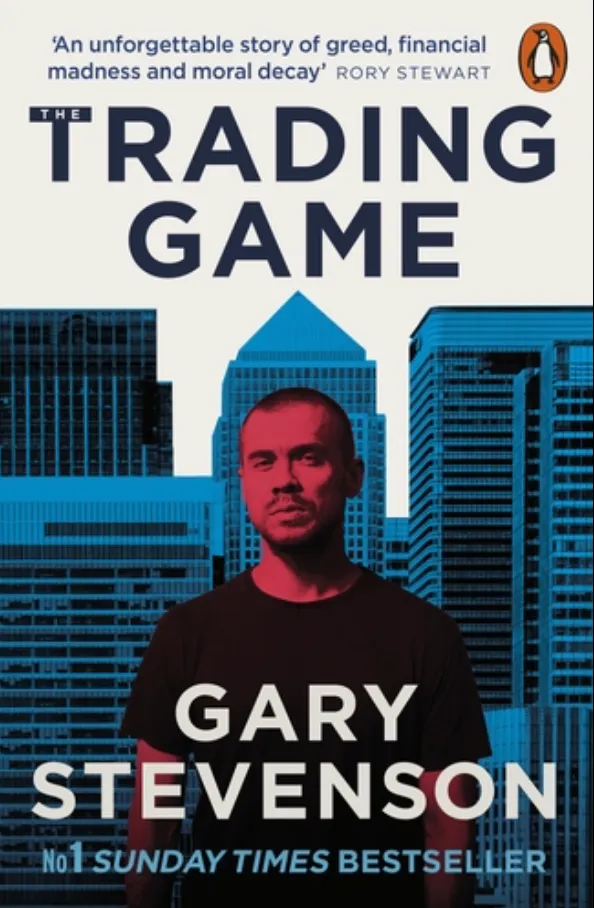
I came across Gary Stevenson’s content online and picked up the book expecting to understand what made him one of the best traders in the world. What I got was that, but also something I didn’t expect. A raw, unfiltered look at the politics, the dysfunction, and the outright madness that happens behind the curtain of one of the world’s top trading desks.
There is no framework to follow and no system to copy. What it gives you is a clear picture of how professional trading actually works, who the game is really designed for, and a few lessons that are genuinely useful for any investor. Here are the four that hit hardest.
THE TRADING GAME: A CONFESSION
Gary Stevenson
Best Wall Street Book of 2024 – Bloomberg
About the Book
Gary Stevenson grew up in working-class Ilford, East London, with Canary Wharf visible from the end of his street. Expelled from grammar school for selling drugs, he made it to the London School of Economics on maths ability alone and won a card-based trading competition run by Citibank that landed him an internship. By his mid-twenties he was Citibank’s most profitable trader, netting twelve million dollars in his first year and tens of millions after that.
His edge was a single uncomfortable idea: interest rates were going to stay low far longer than anyone expected because ordinary people were getting permanently poorer and a declining-wage economy cannot support the recovery that drives rate rises. He was right. He held the position for years while colleagues thought he was wrong. Then he quit, studied at Oxford, and started a YouTube channel about why the rich keep getting richer. He does not spare himself or anyone else in the telling.
TAKEAWAY 1
The edge is not information. It is interpretation.
In 2011, the entire trading floor believed interest rates would rise. Stevenson looked at the same data and saw something different. Ordinary wages were not recovering. An economy built on declining incomes cannot support rising rates. He bet against the consensus and held it for years. He was right.
What separates winners from losers is not data. It is whether your interpretation is correct when the market’s is wrong. Stevenson’s edge was his working-class background. He understood what was happening to ordinary incomes because he had lived it. His colleagues read the same data through a lens of optimism that turned out to be wrong.
Investor tip: Stop trying to find information nobody else has. The professional desks have it before you and in more detail. The game is whether your interpretation is correct when the market is wrong.

Conviction in a well-reasoned view, held long enough, is the edge. Most retail investors abandon correct positions early because the market hasn’t agreed with them yet.
TAKEAWAY 2
You are not trading against other retail investors.
Stevenson spent his days setting prices for transactions worth hundreds of millions. The pension funds and institutions on the other side believed they were getting a fair price. They were getting the price Stevenson decided to offer them. That is not corruption. That is how it works.
Market makers are not neutral. They extract a margin from every transaction. The spread you pay is not a service fee. It is the house taking its cut, every time, regardless of whether you win or lose.
Investor tip: Every time you transact, someone with better information and faster execution is on the other side. Transact as infrequently as possible. Keep costs minimal. Use strategies that don’t require you to be right about short-term price movements. The less you interact with the machine, the less it extracts from you.
TAKEAWAY 3
If you can’t explain it simply, you don’t understand it.
Stevenson describes interest rate trading like this: you are betting on what central banks will do with the price of money. If you think money will stay cheap longer than the market expects, you position accordingly and wait. Trillions in daily volume reduced to two sentences.
On a trading floor, being unclear costs real money. The lesson for investors: if you cannot explain what you own in two sentences, you probably don’t understand it well enough. When positions move against you, not understanding the logic means you have no framework for deciding whether to hold or get out. You are just reacting to a number.

Investor tip: Before you buy anything, write down what it is and why in three sentences. Not the ticker. The actual logic. What has to be true for this to work? If you can’t write those three sentences, don’t buy it yet.
TAKEAWAY 4
Winning at this game has a cost nobody talks about.
Stevenson makes twelve million dollars in his first year. By any measure he has won. He is also coming apart. He stops sleeping. He describes Citibank making eleven million dollars the day of the Fukushima earthquake, when the disaster moved rates in the bank’s favour. Nobody felt anything. It was a number on a screen.
He wants to quit. He can’t. Bonuses are structured on a delay. His visa is tied to his employer. His entire social world is the floor. Citibank has made itself the container of his life. It takes years and lawyers to get out. The system doesn’t let people go easily. That is not a side effect. It is a feature.

Investor tip: The golden handcuffs Stevenson describes exist at every income level. Lifestyle expands to meet salary. The mortgage gets taken out against the bonus. By the time the cage is visible the bars feel load-bearing. The FIRE number exists to dissolve this trap before it closes. Stevenson had to fight his way out. You can build the exit before you need it.
Should you read it?
Yes. It is the best finance memoir ive read in ages. It’s angry, more honest frankly just eye opening at the degenerate behaviour that goes on at the big banks. Stevenson has a significant chip on his shoulder and wears it visibly. I think that somehow makes the book even more enjoyable.
If this book has you thinking about how markets actually work and you want to learn how to trade options, the Alpha Desk is where that conversation happens.
Inside, traders are running simple Wheel Strategy positions generating 2-5% per month from portfolios they already own. It’s the same process I’ve been using to pay for my life since I retired five years ago. A mechanical process, a community doing the work, and a place to compare notes.
Hit the link below and come in.
Cheers,
Andy
Valencia