
Here is a fact most people in their 30s and 40s have not fully processed: the fiscal model most Western countries run on requires a growing population to function. More workers funding fewer retirees. More taxpayers covering the cost of an ageing base. When that pipeline shrinks, governments do not cut spending. They find new ways to charge you.
Germany just handed us a clean example.
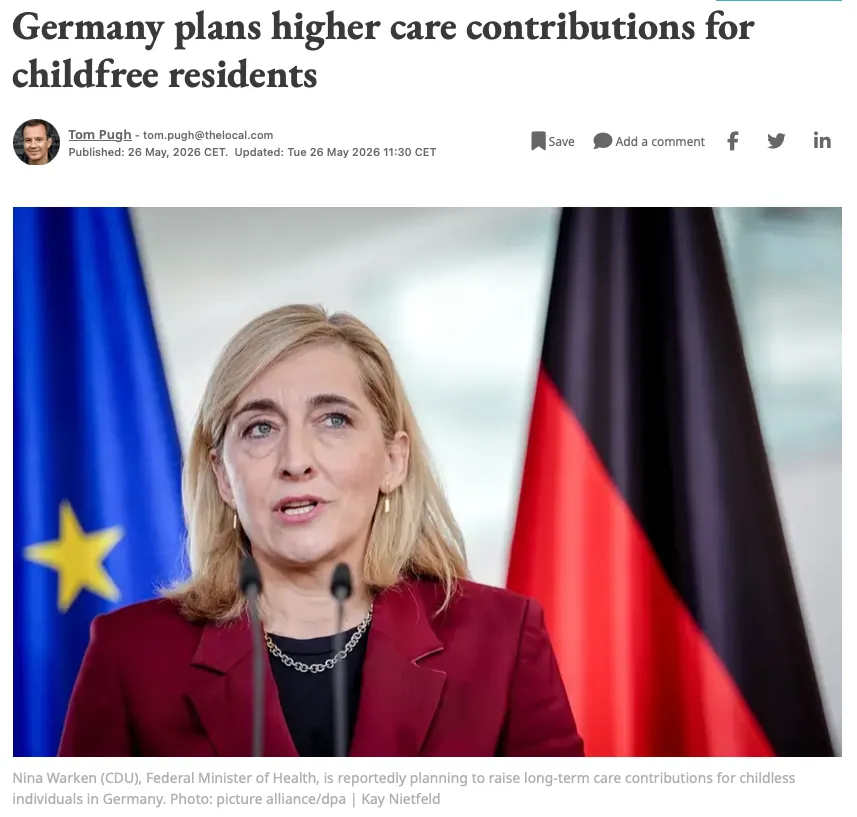
Germany already charges childless adults over 23 a higher long-term care insurance contribution than parents. Currently 4.2% of gross income versus 3.6% for someone with one child. Health Minister Nina Warken’s draft reform proposes raising that childless surcharge further, from 0.6 to 0.7 percentage points, taking the total to 4.3%.
It is not framed as a penalty. It is framed as fairness. Parents, the logic goes, are investing in the future workforce. Childless adults are not. Therefore childless adults should contribute more to the system those future workers will support.
Put it in real numbers. The average gross salary for a full-time employee in Germany is around €54,000 a year. At the proposed rate of 4.3%, a childless adult pays €2,322 in long-term care insurance annually. A colleague on the same salary with one child pays 3.6% — €1,944. That is a €378 gap per year, purely for not having children. The proposed change adds another €54 on top. The individual amounts are not ruinous. That is not the point.
The point is the logic. And that logic will spread. Because the math forces it.
Birth rates across the Western world have been falling for decades, and the people choosing to remain childless are a growing share of that story. A Michigan State University study published in the Journal of Marriage and Family found that the share of non-parents in the US who say they never want children doubled over the past two decades, rising from 14% in 2002 to 29% in 2023. Over the same period, the share who planned to have children fell from 79% to 59%. That is not a blip. That is a structural shift. Governments looking at those numbers are not seeing a lifestyle trend. They are seeing a funding gap.

Germany is not an outlier. It is a preview.
In its 2026 budget, the Australian government announced plans to scrap the 50% CGT discount on investment assets — replacing it with cost base indexation and a 30% minimum tax on net capital gains from 1 July 2027. Negative gearing on established residential properties is being wound back at the same time. Existing arrangements remain unchanged for properties held before Budget night, but investors buying established housing after that date can no longer offset losses against other income like wages. Separately, the Division 296 super tax is now law. It passed Parliament in March 2026, received Royal Assent, and takes effect 1 July 2026 — imposing an additional 15% tax on earnings attributable to superannuation balances above $3 million. You can read the full detail of the Australian tax reforms here.

Then there is the Netherlands. Dutch lawmakers approved a 36% tax on unrealised gains — meaning investors would owe tax on paper profits from stocks, bonds, and crypto before receiving a single cent in cash. The public backlash was immediate and fierce. Finance Minister Eelco Heinen eventually announced a reversal, acknowledging that “something simply hasn’t gone right” and that the law “cannot pass as is.” The government pulled it back for revision. But do not mistake a retreat for a surrender. The taboo has been broken. Taxing wealth you have not yet realised is now a mainstream policy conversation in one of Europe’s wealthiest nations. It will be back, somewhere, in some form.

The pattern is consistent: as the fiscal gap widens, governments work through the list of things people with assets have built, and start taxing them differently.
The CGT discount. The pension balance. The investment property. The childless adult.
Governments increasingly see mobile, solvent people as an untapped gold mine that needs exploiting.
So what do you actually do about it?
Geo-arbitrage is the practical answer. It is the legal framework of choosing where you live, where you are tax resident, and where you generate income — and treating each of those as a deliberate decision rather than a default.
Most people never question any of them. They live where they grew up, pay tax wherever that happens to be, and earn money from whoever will employ them locally. They have no leverage over any of it.
The alternative looks like this. Establish tax residency in a territorial tax system — a country that only taxes income earned within its borders. Your foreign-sourced income, whether from trading, digital products, or investments, falls outside their scope entirely. Countries like Georgia, Panama, Malaysia, and Paraguay all operate this way. Some offer formal visa pathways for remote workers or retirees. None require you to be wealthy to access them.

I moved to Valencia in 2020. Spain is not a zero-tax jurisdiction, but combined with the right corporate structure, the cost of living here runs at a fraction of what the same quality of life costs in London, Sydney, or Auckland. That gap is the point. Lower costs mean you need less income. Less income means less exposure to the tax systems that are tightening around you.
The three variables — where you live, where you pay tax, where you earn — compound when you optimise all three together. Most people optimise none of them.
Your next step is simple. Read about how those three levers work, decide which one you can move first, and start there. You do not need to relocate tomorrow. You need a plan before the window narrows further.
Germany’s childless surcharge increase is €54 a year on an average salary. Trivial in isolation. But it is one data point in a very clear trend: governments in demographic decline will keep finding new ways to charge people who are mobile, solvent, and not producing the next generation of taxpayers. Each individual measure looks small. The cumulative direction is not.
The exit is still open. It will not stay this easy forever.
Germany is already charging you more for being childless. Australia is taxing your investments and your pension. The Netherlands passed a tax on gains you haven’t even realised yet — then pulled it back under pressure. It will return. If you want to understand how to stop being the solution to someone else’s fiscal problem — lower costs, less tax, more freedom — the roadmap is in The Three Levers of Freedom. Grab your copy [here].
Cheers
Andy
Valencia
